Highlights
- What’s the difference between a standing desk converter and a standing desk? A converter sits on your existing desk and lifts your screen and keyboard to standing height. It’s a good fit for home offices, renters, and first-time sit-stand users.
- A full standing desk replaces your desk entirely. It gives you more workspace, a height range of 640mm to 1290mm, and a more stable base.
- Choose a converter if your current desk is solid and you want a quick, cost-effective upgrade.
- Opt for a full standing desk if you stand every day, use multiple monitors, or are furnishing a shared office.
When you weigh up a standing desk converter vs standing desk, you’re deciding whether to replace your current desk or add to it. An adjustable desk replaces your existing desk, while a standing desk converter sits on top of your existing desk.
Both options let you move between sitting and standing positions throughout the workday. The right choice depends on your workspace, equipment, budget, and how many people will use it.
In this guide, we compare a standing desk converter vs. a standing desk side by side so you can choose with confidence. You can also browse our full range of adjustable desks online, or visit our O’Connor showroom to try both options in person.
What is a full standing desk?
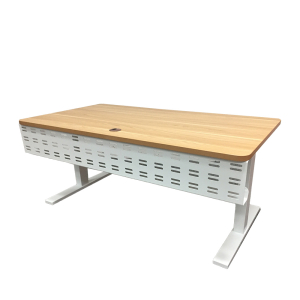
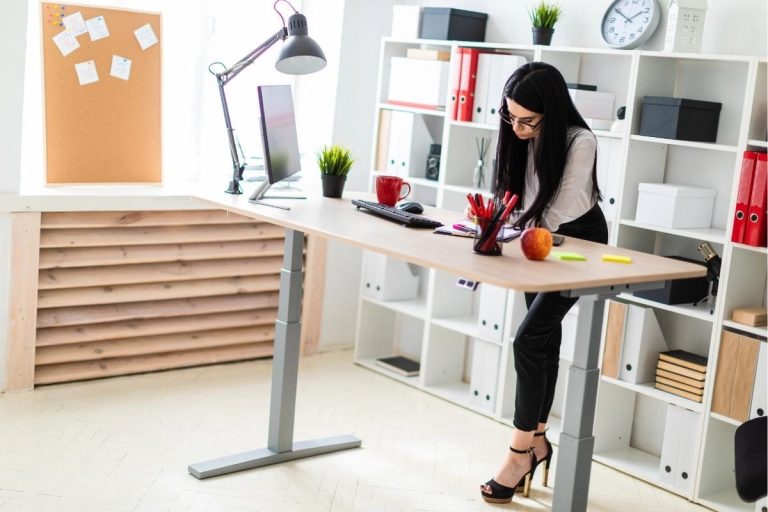
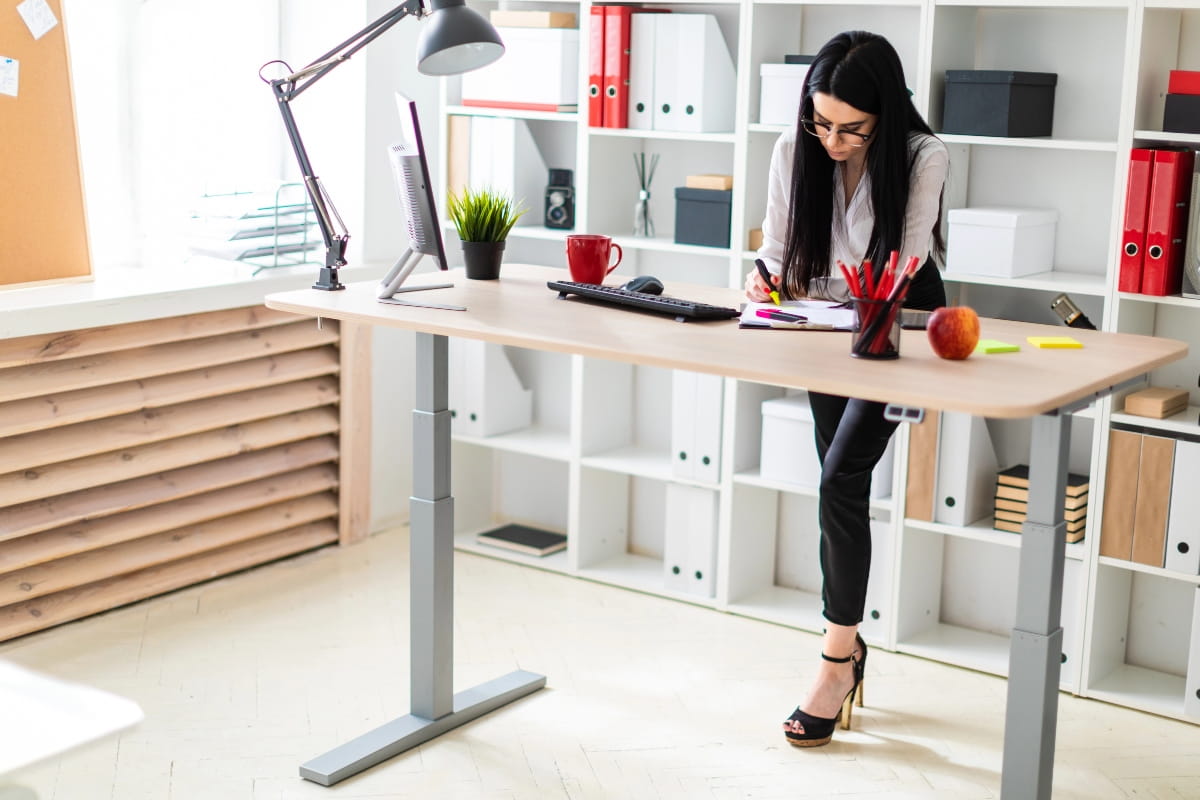
A full standing desk, also called a sit-stand desk or height-adjustable desk, replaces your existing desk entirely. The entire work surface rises and lowers, so your monitors, keyboard, notes, and accessories move together.
Most modern standing desks use electric motors in the legs. You press a button, and the desk moves smoothly to your preferred seated position or standing height.
Our Elevate Sit-Stand Desk – Standard has a motor in each leg for a stable lift. It adjusts from 640mm to 1290mm in height and comes in three sizes:
- 1200mm x 800mm
- 1500mm x 800mm
- 1800mm x 800mm
You can add a modesty panel, power board or cable tray to suit your workspace. If you’re unsure whether standing at work is right for you, start with our guide: Are standing desks good for you?
What is a standing desk converter?
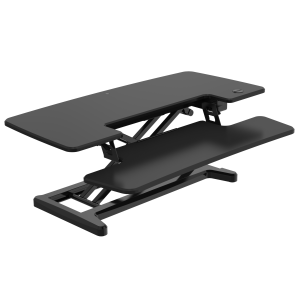
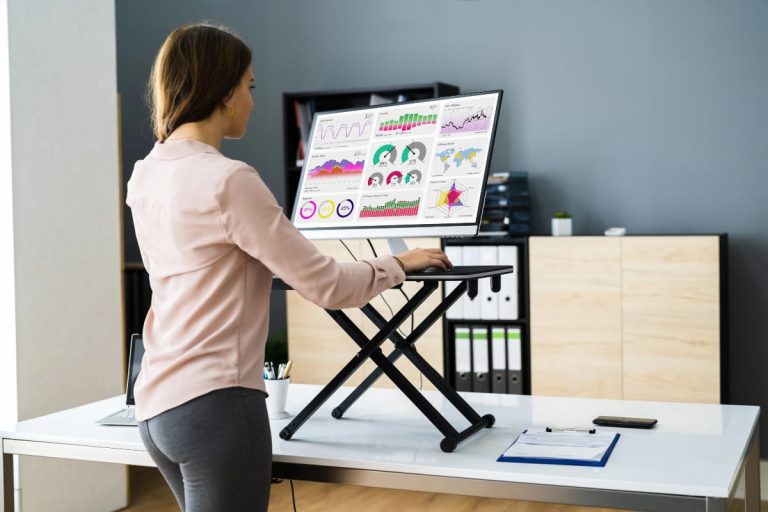
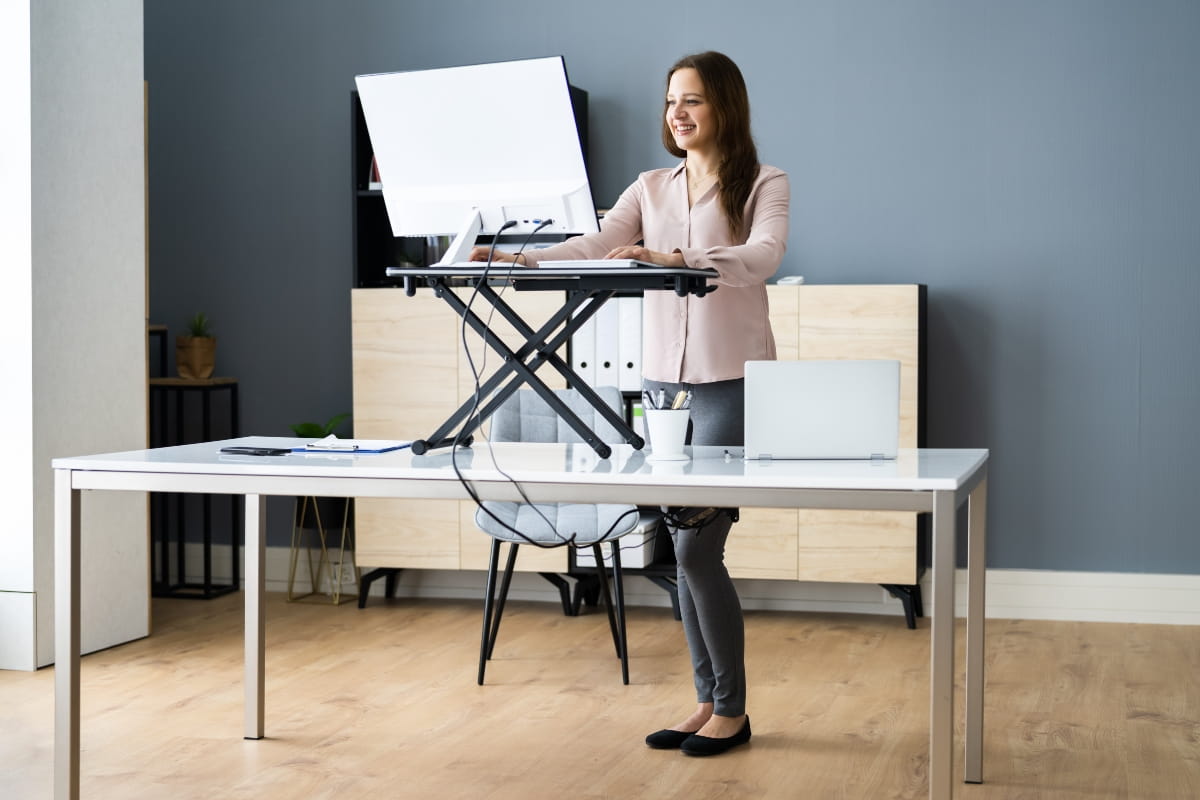
A standing desk converter sits on top of your current desk and raises your screen and keyboard to standing height. You keep your existing desk and simply add a sit-stand platform. You may also see it called a stand-up desk converter, sit-stand desk converter, sit-stand converter or desk riser.
There are three main types of desk converters:
- Flat risers are a single platform that lifts your keyboard, mouse and screen together, usually by around 64mm or more.
- Two-tier converters have a top surface for your computer screen and a separate lower tray for your keyboard and mouse.
- Motorised converters use an electric motor to rise at the press of a button.
Manual flat and two-tier models use a gas spring lift or spring-assisted lift, so you raise and lower them by hand. Gas spring converters provide smooth height transitions without electricity.
Our Elevate Computer Riser is an electric riser with a button built into the work surface. It lifts from 125mm to 505mm above your desk at 22mm per second, includes a keyboard tray and sets up with no tools. Its two-tier design puts your monitor on the top surface and your keyboard and mouse on the lower tray.
A converter is a practical way to try a sit-stand routine without replacing furniture that still works well. The best standing desk converters offer a stable base, enough height range for your body and room for your keyboard and mouse.
Standing desk converter vs standing desk at a glance
A converter suits you if you want to keep your desk and spend less. A full standing desk suits you if you want more space, a wider height range and the most stable surface.
| Feature | Standing desk converter / riser | Full standing desk |
| What is it | Platform that sits on your existing desk | Complete desk that rises and lowers |
| ARTEIL option | Elevate Computer Riser | Elevate Sit-Stand Desk – Standard or L Shape |
| Price from (incl. GST) | $550 | $690.80 |
| Work surface | 880mm or 950mm wide x 415mm deep | 1200mm to 1800mm wide x 800mm deep |
| Height adjustment | 125mm to 505mm above your desk | 640mm to 1290mm from the floor |
| Whole desk moves | No, only the platform | Yes, everything on the desk |
| Setup | Place on desk, no tools needed | Assembly required, or assembled delivery |
| Best for | Renters, home offices, trial runs, budget upgrades | Full-time users, multiple monitors, shared or commercial offices |
Note: Prices are taken from our product pages at the time of writing and exclude shipping.
How a desk riser vs standing desk compares in daily use
The biggest differences show up in five areas. Here’s what each means for your comfort and budget.
1. Desktop space and monitor capacity
A full standing desk gives you the most desk space. With an 800 mm deep top, you have room for dual monitors, a laptop, documents, and a phone, and you can move it all with you.
SafeWork SA recommends choosing a sit-stand desk that fits all your equipment, such as two monitors, a keyboard and a place to write.
A converter only lifts what sits on its platform. Anything left on the desk below, such as office supplies, stays at sitting height. For dual-monitor setups, use the 10mm bolt hole on the Elevate Computer Riser to mount a monitor arm.
2. Height range and ergonomic adjustment
Good ergonomics starts with your elbows at around 90 degrees and your screen at or just below eye level, which helps reduce neck strain and eye strain. A full desk lets you set the entire work surface to your exact elbow height, suiting a wide range of users from shorter to taller staff. Many electric models also let you save your preferred height settings, so you can switch positions in seconds.
With a converter, your standing height depends on your existing desk plus the platform’s lift. Most standard desks sit around 720mm high, so a riser adds enough height for most users. Very tall users should check the numbers before buying. Our guides on standing desk height and standing desk ergonomics explain how to find your ideal setting.
3. Stability and weight capacity
A full standing desk with motors in each leg spreads the load evenly across the frame. This gives you a steady surface for typing, writing and heavier equipment. Build quality matters too, as a solid frame keeps the desk steady at full height.
Converters can be very stable at sitting height, but every platform has a weight limit. If you use heavy monitors or lean on your keyboard while you type, ask our team about the right option for your equipment.
A wobbly setup is one of the most common standing desk mistakes and can discourage you from standing at all.
4. Installation and assembly
A converter is the fastest way to get started. The Elevate Computer Riser needs no tools, so you can unbox it, place it on your desk and plug it in.
A full standing desk takes more effort, as you need to remove your old desk and assemble the new frame. To make it easier, you can pick up an assembled desk from our O’Connor showroom or have it delivered and assembled on site within 25km of the Perth CBD.
5. Cost and long-term value
A standing desk converter costs less upfront, starting from $550. It also lets you keep a quality desk you already own.
A full standing desk costs more, starting from $690.80, but it replaces two pieces of furniture with one. For people who stand every day, it often delivers better long-term value through more space, a wider height range and fewer compromises.
Which option works best for a small office?
For most home offices and small workspaces, a standing desk converter is the simplest place to start. It adds sit-stand flexibility without taking up extra floor space.
Here are some common scenarios:
- You work from home at a desk you like. Add a desk converter and keep your existing furniture. It’s a quick, tool-free upgrade.
- You rent or move often. A converter is easy to pack up and take with you, with no large frame to dismantle.
- You want to test standing before committing. A converter lets you build a routine first. Our guide on how long you should stand at a standing desk can help you ease in.
- You’re setting up a new home office from scratch. If you need a desk anyway, the Elevate Sit-Stand Desk – Standard in the 1200mm size fits most spare rooms and gives you a full sit-stand surface.
Whichever you choose, good posture still matters. Read our tips on standing desk posture to get the most from your setup.
Which option works best for a commercial workplace?
For most commercial offices, a full standing desk is the stronger long-term choice. It gives every staff member a sit stand workstation with the full height range, a stable surface and room for all their equipment.
This matters most in these situations:
- Shared desks and hot-desking. Staff of different heights can each find their correct position at the touch of a button.
- Multi-monitor workstations. Finance, design and admin teams often need space for two or more screens, plus documents.
- New fit-outs. If you’re replacing desks anyway, a sit-stand desk avoids buying a desk and a converter separately.
- OH&S planning. Safe Work Australia encourages workplaces to reduce long periods of sitting. A height-adjustable desk makes it easier to set up each workstation to suit the person using it.
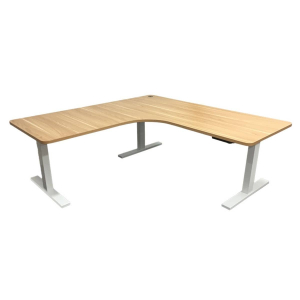
Converters still have a place in larger workplaces. They are a cost-effective way to support staff with specific needs, such as recovery from a back injury, without replacing an entire row of desks. Our Elevate desks are also available in an L Shape for managers and corner workstations that need extra space.
If you’re planning a bulk order or a government purchase, our team can help you mix desks and converters to suit your staff and budget.
Choosing between an ARTEIL desk, riser and converter
So, should you replace your desk or add a converter? The answer to the standing desk converter vs standing desk question starts with your current desk and how you plan to use it.
| Your situation | Best option | Price from (incl GST) |
| Your current desk is solid, and you want an electric lift with a keyboard tray | Elevate Computer Riser | $550.00 |
| You need a new desk, or you plan to stand for much of the day | Elevate Sit-Stand Desk – Standard | $690.80 |
| You need extra work surface for a corner or manager’s office | Elevate Sit-Stand Desk – L Shape | $1,075.80 |
A standing desk only does half the job. Pair it with a quality ergonomic chair so you stay supported when you sit, and set your chair height to match your desk.
The best way to decide is to try both. Visit our O’Connor showroom at 4/95 Garling Street to test our adjustable desks in person. You can also call us on (08) 9337 8399 or email info@arteil.com.au for personalised advice. We deliver Australia-wide.
Frequently asked questions
A standing desk converter gives you the same core benefit: switching between sitting and standing. A full standing desk offers more work surface, a wider height range and greater stability. For occasional standing, a converter works well. For daily use or multiple monitors, a full desk is usually the better fit.
You can buy the Elevate Computer Riser directly from ARTEIL. We deliver every standing desk converter Australia-wide from our O'Connor showroom in Perth. Visit us to try it in person, or contact us for a quote, including freight.
Most likely, yes. The Elevate Computer Riser has a 700mm x 375mm base, so it suits most standard office desks. Measure your desk depth, and make sure it's sturdy and level before you buy. If you're unsure, send us your desk measurements, and we'll help.
The Elevate Computer Riser lifts from 125 mm to 505 mm above your desk. Add this to your desk height to find your total standing height. Our standing desk height guide shows how to find the perfect height for your body.
An anti-fatigue mat isn't essential, but it can reduce pressure on your feet and legs when you stand for longer periods. Supportive footwear and regular changes between sitting and standing also help you stay comfortable.